
Live Coding Interview Tips: How to Stay Calm and Communicate
Master live coding interviews with these battle-tested communication strategies. Learn what separates candidates who pass from those who fail—even when solving the same problems.
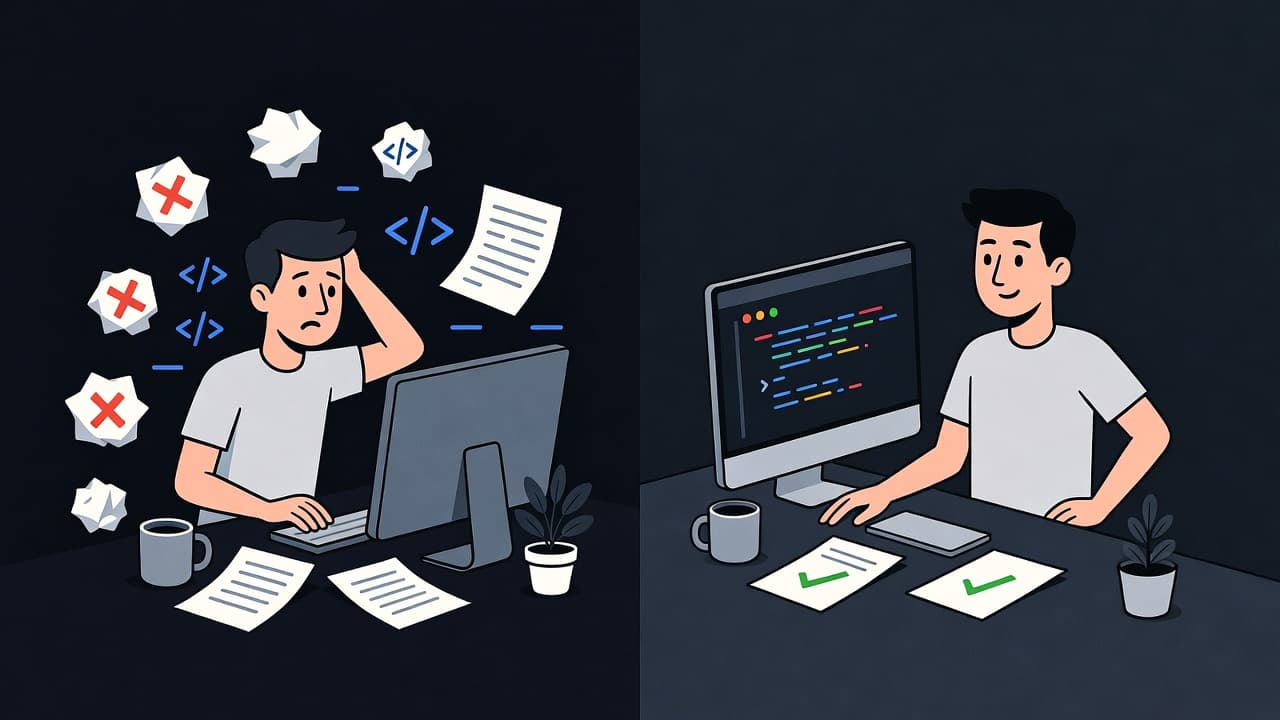
I've watched 200+ coding interviews.
The weird part? Candidates who failed often solved problems just as well as those who passed.
The difference? How they communicated while doing it.
When Good Code Isn't Enough
Last week, a candidate solved a hard problem in 18 minutes.
Perfect solution. Optimal complexity. Clean code.
They failed.
Why? Complete silence the entire time.
The interviewer said: "I couldn't evaluate their process because I didn't see any process. Just typing."
Meanwhile, another candidate took 35 minutes on a medium problem, made two mistakes, but passed easily.
They narrated every decision.
The 3 Phases of Live Coding
Phase 1: The First 5 Minutes (Make or Break)
Don't start coding immediately.
Senior engineers spend 3-5 minutes planning. Here's what interviewers expect:
Restate the problem: "We're finding all pairs that sum to a target and returning unique pairs. Correct?"
This confirms understanding and reveals edge cases.
Ask the right questions:
- Expected input size?
- Can array contain negative numbers?
- Optimize for time or space?
Discuss approaches: "Three ways: nested loops O(n²), sorting + two pointers O(n log n), or hashmap O(n). I'll use hashmap for large inputs. Sound good?"
You haven't coded yet, but you've demonstrated senior thinking.
Phase 2: The Coding Phase (Narrate or Die)
Your interviewer cannot read your mind.
Say this while coding:
- "Creating a hashmap to store values..."
- "Iterating through the array..."
- "Checking if complement exists..."
- "Adding to results..."
Sounds robotic? Maybe. But it shows your thought process—half of what's being evaluated.
Pro tip: Narrate wrong ideas too
"Wait, I was about to use a list, but that's O(n) lookups. A set would be better."
Catching your own mistakes scores more points than getting it right the first time.
Phase 3: The "I'm Done" Moment (But You're Not)
-
❌ Bad: "It works, I'm done."
-
✅ Good: "This works in O(n) time with O(n) space. Should I discuss optimization tradeoffs?"
Even if optimal, ask about optimization. It signals you understand tradeoffs.
When You Get Stuck (Everyone Does)
Your interviewer expects you to get stuck. They want to see how you handle it.
Recognize it early: 2 minutes of silence = you're stuck. Don't wait for 10.
-
❌ Bad response: [10 minutes of silence] Interviewer: "How's it going?" You: "Uh... still thinking..."
-
✅ Good response: [2 minutes] You: "Working through ideas. Considering recursion, but concerned about stack overflow. Thinking iterative instead..."
Ask for hints strategically:
-
❌ "I don't know. Can you give me a hint?"
-
✅ "I'm considering sliding window but not seeing how to handle duplicates. Am I on the right track, or should I pivot?"
Shows what you've tried and asks specifically.
Test Before the Interviewer Does
The difference between mid-level and senior.
Don't say "I'm done." Say:
"Let me trace through with an example to verify."
Then walk through:
"Input [2, 7, 11, 15], target 9:
- First iteration: num=2, complement=7, hashmap empty, add 2
- Second iteration: num=7, complement=2, found in hashmap, return [2,7]"
Finding bugs yourself = major points. Waiting for interviewer to find them = junior.
Test edge cases: "Empty array... returns empty array as expected."
The Communication Scorecard
Your interviewer checks these boxes:
- ✅ Clarified requirements before coding
- ✅ Discussed multiple approaches
- ✅ Explained reasoning out loud
- ✅ Caught their own bugs
- ✅ Tested with examples
- ✅ Discussed optimization
Notice what's not on the list? "Solved perfectly."
You can score 5/6 even with buggy code. Or solve perfectly and score 2/6 if silent.
Practice This One Weird Trick
Before your next interview, solve LeetCode problems while talking to yourself.
Seriously.
Set a 45-minute timer and narrate your entire thought process. Feels ridiculous at first, but builds the muscle memory.
Even better: Practice with an AI co-pilot like Hinto. Ask questions, discuss approaches, explain reasoning.
When you're comfortable "conversing" about code with AI, you're ready for human interviewers.
The goal isn't AI solving for you—it's getting comfortable articulating while coding.
The Bottom Line
Live coding interviews test how you think, communicate, and work under pressure.
Winners aren't necessarily the strongest coders. They're the ones who make their thinking visible.
Master these 3 skills:
- Plan first → 3-5 minutes discussing approaches
- Narrate constantly → talk through every decision
- Test yourself → find bugs before interviewer does
Do this consistently, and you'll pass even when your code isn't perfect.
The real secret? Your interviewer knows the code won't be perfect.
They just want to see you know how to get there—and that they'd enjoy working with you while you do.
