
I Failed 5 FAANG Interviews Because I Was Silent: A Founder's Story
After failing Google, Meta, and Amazon interviews despite solving problems perfectly, I learned the hard truth: technical interviews are performance art. Here's what nobody tells you.
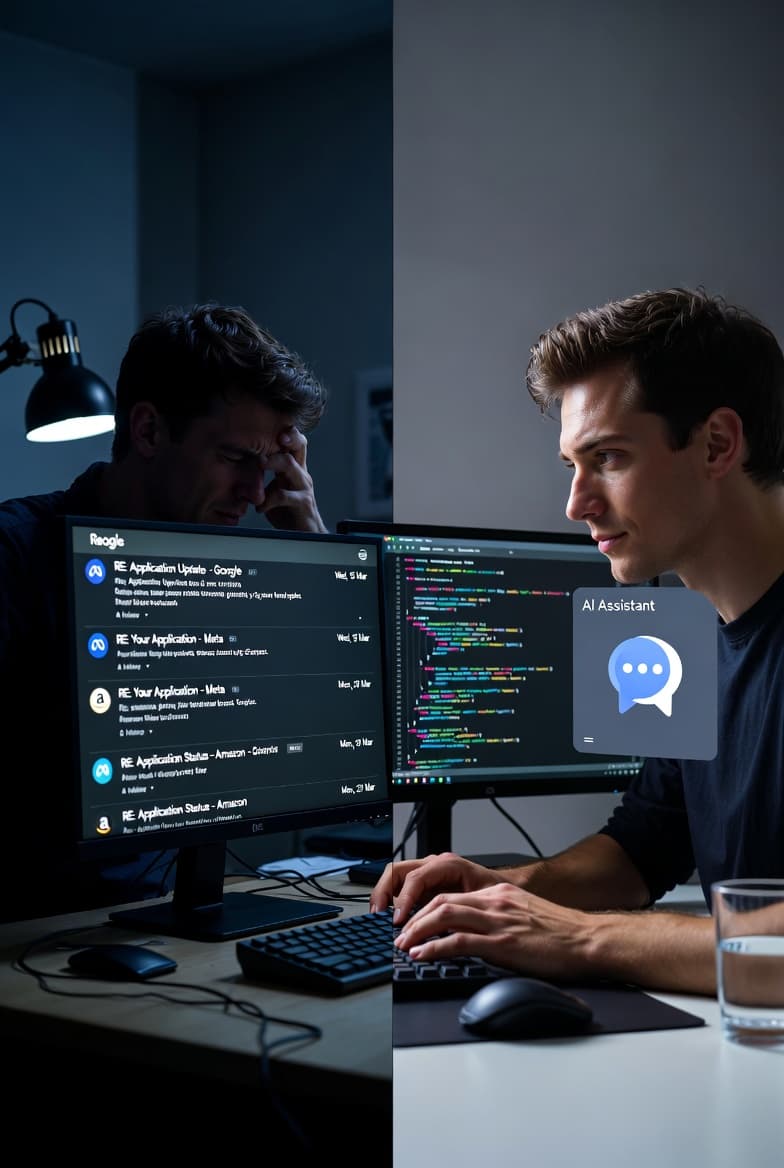
I solved the problem perfectly in 22 minutes.
Clean code. Optimal time complexity. Edge cases handled.
The interviewer said: "Thanks, we'll be in touch."
Two days later: Rejection email from Google.
That was interview #3 of 5 consecutive FAANG failures.
The Pattern I Couldn't See
After the fifth rejection (Amazon, if you're counting), I did something most candidates never do: I asked for detailed feedback.
Here's what multiple interviewers told me:
"Your solutions were correct, but we had no idea how you got there. You were completely silent for 20+ minutes. We couldn't evaluate your problem-solving process."
That hit me like a truck.
I wasn't failing because I couldn't code.
I was failing because I couldn't communicate while coding.
The Silent Killer (Literally)
Let me be specific about what happened in those interviews:
Google (L4 Role):
- Problem: Design a data structure for LRU cache
- My approach: Hashmap + doubly linked list
- Time to solution: 18 minutes
- Words spoken: ~47 total (I counted later from my notes)
- Result: "Not moving forward"
Meta (E4 Role):
- Problem: Find median in a stream of integers
- My approach: Two heaps (max heap + min heap)
- Time to solution: 22 minutes
- Communication: Silence, then "I'm done"
- Result: "Doesn't meet the bar"
Amazon (SDE2):
- Problem: Design a rate limiter
- My approach: Sliding window with Redis
- Time to solution: 35 minutes
- My mistake: Silent for 25 minutes, then rapid-fire explained everything in 2 minutes
- Result: "We're moving in a different direction"
See the pattern?
Perfect solutions. Zero communication. Consistent rejection.
What I Thought vs. What They Thought
What I thought I was showing:
- Deep focus
- Strong problem-solving
- Confidence (I don't need help)
- Efficiency (no wasted words)
What interviewers actually saw:
- Possibly stuck (long silences = confusion)
- Poor communication skills (won't collaborate well)
- Unclear thought process (can't evaluate senior-level thinking)
- Potentially memorized solution (no reasoning shown)
The brutal truth: In those 45 minutes, interviewers weren't just evaluating my code.
They were evaluating whether they'd want to work with me for 40 hours a week.
Silence doesn't inspire confidence in collaboration.
The Breakthrough: Interview #6
After 5 failures, I changed everything.
Interview #6 was at a startup (Series B, ~200 people).
Same problem complexity. But this time, I narrated everything:
"Let me restate the problem to make sure I understand..." "I'm considering two approaches: X and Y. X would be O(n²) but simpler to implement. Y would be O(n) with a hashmap..." "I'll go with the hashmap approach because we're optimizing for speed..." "Creating the hashmap now. I'll use the value as a key and index as value..." "Wait, that won't work for duplicates. Let me adjust—using a set instead..." "Okay, iterating through the array. For each element, checking if complement exists..." "Found a bug in my logic here—off by one error. Let me trace through with an example..."
The interviewer interrupted me halfway through:
"This is great. I can already tell you understand the problem deeply. Let's move on to the optimization discussion."
Offer received 48 hours later.
Same coding ability. Completely different outcome.
The only variable? Communication.
The 3 Lessons That Changed Everything
Lesson 1: Interviewers Need to Hear Your Process
When you're silent, interviewers assume the worst: you're stuck, confused, or memorizing.
When you narrate, they see:
- Your problem-solving approach
- How you handle uncertainty
- Your ability to self-correct
- Senior-level thinking patterns
Action: Narrate every decision. Even wrong ideas that you self-correct.
Lesson 2: Interviews Are Performance Art
The best engineer doesn't always get the offer.
The engineer who performs best in the artificial 45-minute format does.
This isn't about being fake. It's about making your invisible thought process visible.
In real work: You think silently, code in isolation, ask questions asynchronously.
In interviews: You must externalize everything in real-time.
Different skill. Same importance.
Lesson 3: "I'm Done" Is Never Done
After solving a problem, the average candidate says: "It works, I'm done."
The candidate who gets offers says:
"This works and runs in O(n) time with O(n) space. I could reduce space to O(1) by modifying the input array in-place, but that has the tradeoff of mutating the input. Let me walk through a test case to verify edge cases..."
Two extra sentences. 5x better signal.
Why I Built Hinto
After passing that 6th interview and eventually landing at a startup, I kept thinking about those 5 failures.
Each rejection cost me:
- ~$50K+ in compensation difference (vs. if I'd passed)
- 2-3 months of prep time wasted
- Confidence damage that took months to rebuild
- Opportunity cost of roles I couldn't reapply to for 6-12 months
Total cost of not knowing "the game": ~$300K+ and 8+ months.
But here's what bothered me most:
I wasn't unique.
Talking to other engineers, I heard the same story over and over:
"I can solve LeetCode hards. But in real interviews, I freeze up." "I don't know what to say while I'm coding." "I solved it perfectly but failed the behavioral."
The pattern was clear: The interview game has rules that nobody explicitly teaches.
That's why I'm building Hinto.
What Hinto Does Differently
Most interview prep tools focus on what to code.
Hinto focuses on how to communicate while coding.
During Practice:
- AI analyzes not just your solution, but your communication approach
- Get real-time feedback: "You've been silent for 3 minutes—narrate your thinking"
- Practice explaining trade-offs, edge cases, and optimizations out loud
- Build muscle memory for the "performance" aspect of interviews
The Goal: Turn communication during coding into a habit, not an afterthought.
During Real Interviews:
- Invisible AI assistant (doesn't appear on screen share)
- Real-time hints when you're stuck (keeps you in flow state)
- Pattern recognition support (instant identification of problem types)
- Reduces stress so you can perform at your actual skill level
This isn't about cheating. It's about performing at your best when stakes are highest.
The Mistakes I See Every Day
Now that Hinto is in private beta, I watch hundreds of practice sessions weekly.
These mistakes still kill offers:
-
❌ Starting to code in under 2 minutes (skip planning phase)
-
❌ Going silent for 5+ minutes (interviewer assumes you're stuck)
-
❌ Not testing your code (waiting for interviewer to find bugs)
-
❌ Saying "I'm done" too early (missing optimization discussion)
-
❌ Poor behavioral stories (weak STAR format, no measurable results)
-
✅ What works:
3-5 minute planning phase before touching code
Constant narration of your thought process
Self-correction ("Wait, that won't work because...")
Proactive testing with examples and edge cases
Optimization discussion even when solution is correct
The Real Interview Game
Here's what I wish someone had told me before interview #1:
Technical interviews test 3 skills:
- Coding ability (can you implement a solution?)
- Communication (can you explain your thinking?)
- Performance (can you do both under pressure?)
Most candidates optimize only for #1.
The ones who get offers optimize for all three.
Coding ability gets you in the door. Communication gets you the offer. Performance (staying calm, clear, confident) ties it together.
How to Avoid My 5 Failures
If you take nothing else from this story, remember:
Before your next interview:
Practice out loud - Solve 10 LeetCode problems while talking to yourself (yes, seriously)
Record yourself - Watch for long silences and unclear explanations
Get feedback - Use an AI co-pilot to analyze your communication approach
Simulate pressure - Do timed mocks with real interviewers (or AI)
Nail behavioral - Prepare 8 STAR stories before the interview, not during
During your interview:
Restate the problem in your own words first
Narrate constantly - "I'm considering X approach because..."
Catch your own bugs - Test before the interviewer does
Discuss optimizations - Always ask about trade-offs
Stay calm - Use tools like Hinto to reduce stress
The Bottom Line
I failed 5 FAANG interviews in a row.
Not because I couldn't code.
Because I didn't understand the game.
Interviews aren't tests of engineering ability.
They're tests of how well you perform in an artificial, high-pressure, 45-minute scenario.
The skills that make you a great engineer (deep focus, independent problem-solving, async communication) are different from the skills that get you hired (real-time narration, live collaboration, verbal explanation).
You need both.
That's why I built Hinto—to help engineers close the gap between their actual abilities and their interview performance.
Because nobody should lose $300K in offers and 8 months of their life learning what I learned the hard way.
Your actual coding skills shouldn't cost you your dream job.
Try Hinto for Your Next Interview
Ready to avoid my mistakes? Hinto helps you:
- ✅ Practice communication - Real-time feedback on how you explain code
- ✅ Build confidence - Reduce anxiety with invisible AI support
- ✅ Perform better - Real-time hints, pattern recognition, optimization tips
- ✅ Land offers - Turn skills into offers at Google, Meta, Amazon
Free trial, no credit card required.
Related Articles:
